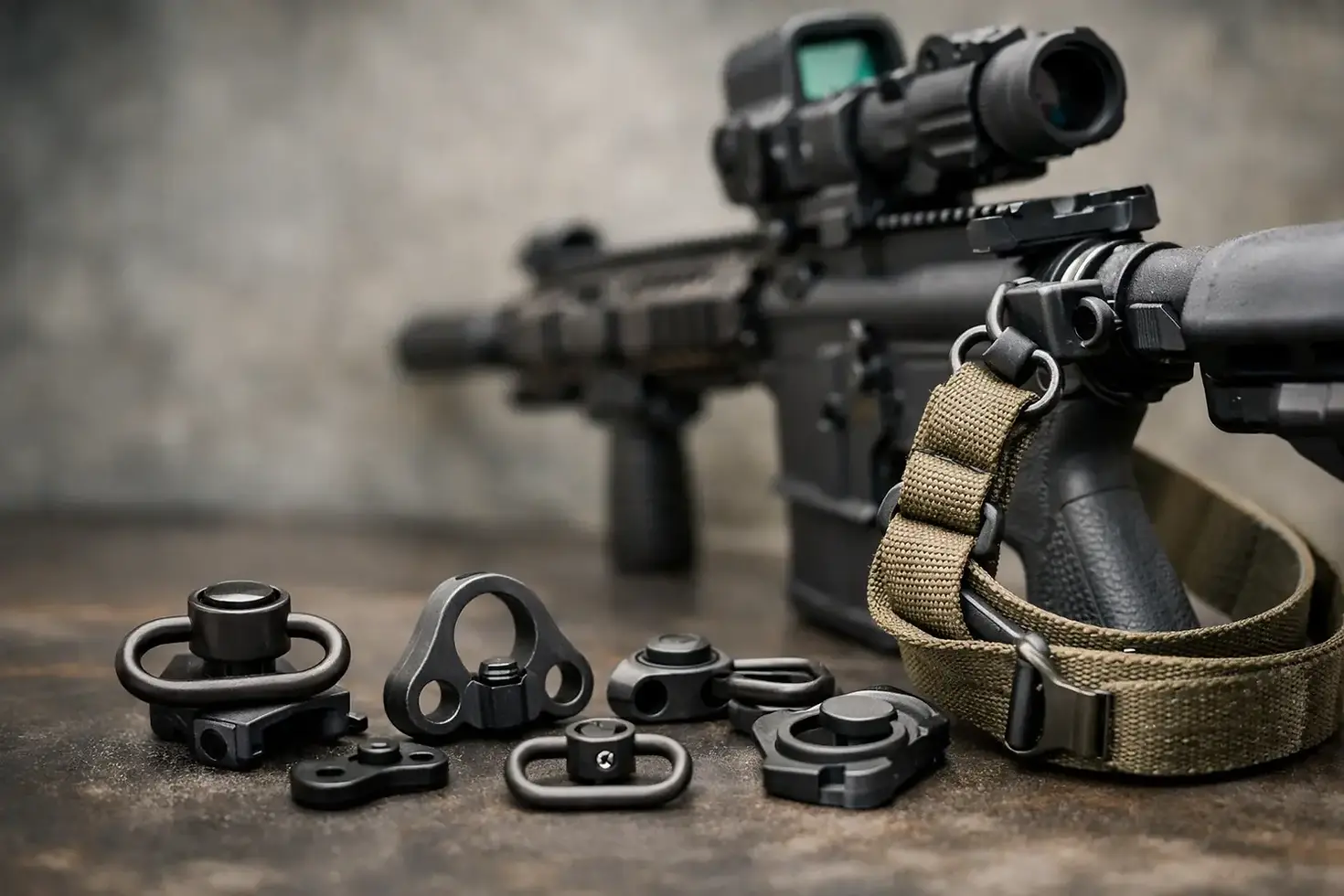
Best Rifle Sling Mounts for Mission-Ready Rifles
A rifle sling is not an afterthought. It is the retention system that keeps your carbine controlled while you move, transition to a sidearm, climb terrain, work a barricade, or simply free both hands at the range. The best rifle sling mounts do more than hold a strap in place. They establish where the rifle rides, how quickly it presents, and whether your setup stays quiet and secure under hard use.
For a mission-ready AR-15 or tactical rifle, the right mount is rarely the most complicated option. It is the interface that matches your sling, your handguard, your stock, and the way you actually run the gun. A mount that looks clean on a workbench but binds the sling, rattles under movement, or places the rifle in an awkward carry position has failed the mission.
What Makes the Best Rifle Sling Mounts?
The best mount is not a universal part. A lightweight 16-inch carbine used for training will have different requirements than a suppressed defensive rifle, a long-range gas gun, or a hunting bolt rifle carried over uneven ground. Start with the sling system itself. Most serious rifle setups use a two-point sling because it provides stability, adjustability, and better control during movement.
Your mounts must support that system without creating weak points. Material quality matters. Look for steel or high-strength aluminum hardware with a durable finish that resists corrosion, abrasion, and repeated impact. A mount must also lock into its host interface without shifting. Even slight rotation or looseness becomes obvious once the rifle is carried for hours.
Placement is just as critical. The front mount should give the support arm room to work the handguard without rubbing, snagging, or forcing the sling across controls. The rear mount should keep the rifle close to the body while allowing a clean shoulder transition. Those requirements eliminate plenty of bargain-bin hardware.
QD mounts: the fast, flexible choice
Quick-detach, or QD, mounts are the standard for many modern AR-15 loadouts. They use a push-button socket and swivel system that lets the sling detach rapidly when needed. This is useful for swapping between rifles, fitting a rifle into storage, removing a wet or contaminated sling, or changing a setup from a two-point carry configuration to another supported role.
A quality QD swivel should seat with an audible, positive lock and resist accidental release. Anti-rotation QD sockets are especially valuable on carbines because they prevent the swivel from spinning freely and twisting the sling into a knot. On a hard-running rifle, that small detail saves frustration and preserves a consistent carry position.
QD systems do bring a trade-off. They add moving parts, and cheap swivels can rattle, corrode, or release unpredictably. Use proven hardware and inspect it like any other load-bearing component. If the push button is gritty, the detents are worn, or the socket no longer retains the swivel firmly, replace it.
Fixed loops and slots: simple hardware that keeps working
Fixed sling loops, webbing slots, and traditional attachment points have a major advantage: simplicity. There is no button to press, no ball bearings to maintain, and little risk of an accidental disconnect. For rifles dedicated to field carry, hunting, or austere use, a fixed attachment can be the right call.
Modern handguards often include integral slots designed for direct webbing attachment. This creates a low-profile connection with minimal weight and no added hardware hanging off the rail. It can also reduce noise compared with a metal QD swivel striking the receiver or handguard.
The drawback is reduced flexibility. Removing the sling takes longer, and a direct webbing connection may wear over time if it rides against sharp edges. Check the slot finish and inspect the sling material routinely. If your rifle spends long days outside, exposed to mud, brush, and weather, simple fixed hardware has real appeal.
Rail-mounted sling mounts: useful when positioned with discipline
Picatinny rail sling mounts remain relevant, particularly on older handguards or rifles without built-in QD sockets. They let you add a sling point exactly where the rail allows, whether that means a QD cup, loop, or clamp-on stud adapter.
The key is restraint. A rail-mounted sling mount should not turn the front end of the rifle into a snag hazard. Avoid placing it where it interferes with a support-hand grip, weapon light activation, bipod placement, or backup sight picture. On a carbine, many shooters find that a front-side mounting point near the forward portion of the handguard gives the rifle room to hang naturally without crossing the controls.
Choose mounts with secure crossbolts and recoil-resistant clamping surfaces. A mount that walks loose is more than an annoyance. It can shift the sling under load, damage rail surfaces, and leave the rifle unsupported at the worst possible moment.
Front Sling Mount Placement for AR-15 Carbines
The front attachment point determines much of the rifle's behavior when slung. Mount it too far rearward and the rifle can hang awkwardly, crowd the magazine well, and resist a fast presentation. Mount it too far forward and the sling may pull across the support hand or create unnecessary leverage when carrying the rifle close to the body.
For most AR-15 setups, a forward-side mounting point on the support-hand side is a strong baseline. A right-handed shooter commonly benefits from a mount on the left side of the handguard, while a left-handed shooter often reverses that arrangement. This lets the sling lie flatter against the chest and keeps it away from the ejection port side.
That is a baseline, not a rule. Suppressors, lights, laser units, hand stops, and grip preferences can all change the answer. Shoulder the rifle, tighten and loosen the sling through its adjustment range, then test how it rides while walking, kneeling, and bringing it to the firing position. Hardware should support your movement, not dictate it.
Rear Sling Mount Placement Changes Rifle Control
The rear mount has a direct effect on how tightly the rifle can be secured to the body. Receiver end plate mounts are popular because they position the attachment point close to the centerline of the rifle. This can make a carbine feel compact and controlled when cinched down.
But an end plate mount is not always the best choice. It can put the sling near the charging handle, selector, and rear receiver area, where some shooters experience interference during transitions or manipulations. A stock-mounted QD socket or fixed slot usually provides a cleaner, more familiar carry angle and can be easier to manage with heavier rifles.
For defensive and tactical carbines, test both locations if your stock and receiver support them. The right rear point is the one that keeps the rifle stable without preventing you from operating it quickly. There is no value in a sleek setup that traps the sling under your arm every time you shoulder the rifle.
Match the Mount to the Sling Width and Hardware
A sling mount is only as capable as the connection between the mount, swivel, and sling body. Standard swivels are commonly designed around 1.25-inch webbing, while many modern tactical slings use 1-inch or 1.25-inch straps. Confirm compatibility before committing to a setup.
Do not force a wide sling through a narrow loop or use improvised hardware that pinches the webbing. It can abrade the material, limit adjustment, and create a failure point. The sling should move freely when you adjust it, yet remain controlled when the rifle is carried.
Noise deserves attention as well. Metal hardware against metal receivers can announce every step. Some shooters use protective sleeves, tape, or purpose-built silencers around contact points. Keep any noise reduction solution clear of release buttons, adjustment tabs, and moving controls. Quiet gear is useful only when it remains fully functional.
Common Sling Mount Mistakes That Cost You Time
The first mistake is buying mounts before deciding on the sling and rifle role. A QD-heavy setup can be excellent, but it is unnecessary if the rifle has fixed slots and will always wear the same sling. The second is treating the mount as cosmetic hardware. Sling points take repeated tension, sudden impacts, and body weight during awkward movement. Buy hardware built for that load.
Another mistake is mounting both points on the same side without testing the rifle. It may work well for one body type and carry style but cause rolling, tangling, or poor transitions for another. Finally, do not overlook maintenance. Dirt, carbon residue, sweat, and rain all reach sling hardware. Periodically check fasteners, sockets, swivels, webbing, and stitching before range days or field use.
Build a Sling System You Can Trust
A dependable rifle carry system comes from matching proven mounts to a real purpose. QD sockets deliver rapid modularity. Fixed loops and direct webbing slots keep things low-profile and uncomplicated. Rail-mounted options solve placement problems when used with care. None is automatically superior without considering the rifle, the sling, and the mission.
Retribution Tactical serves shooters who expect their equipment to hold up when range conditions turn into real field conditions. Set up your rifle, load the sling, and spend time moving with it before calling the job complete. The correct mount disappears into the system. The wrong one makes itself known every time the rifle leaves your hands.


Comments