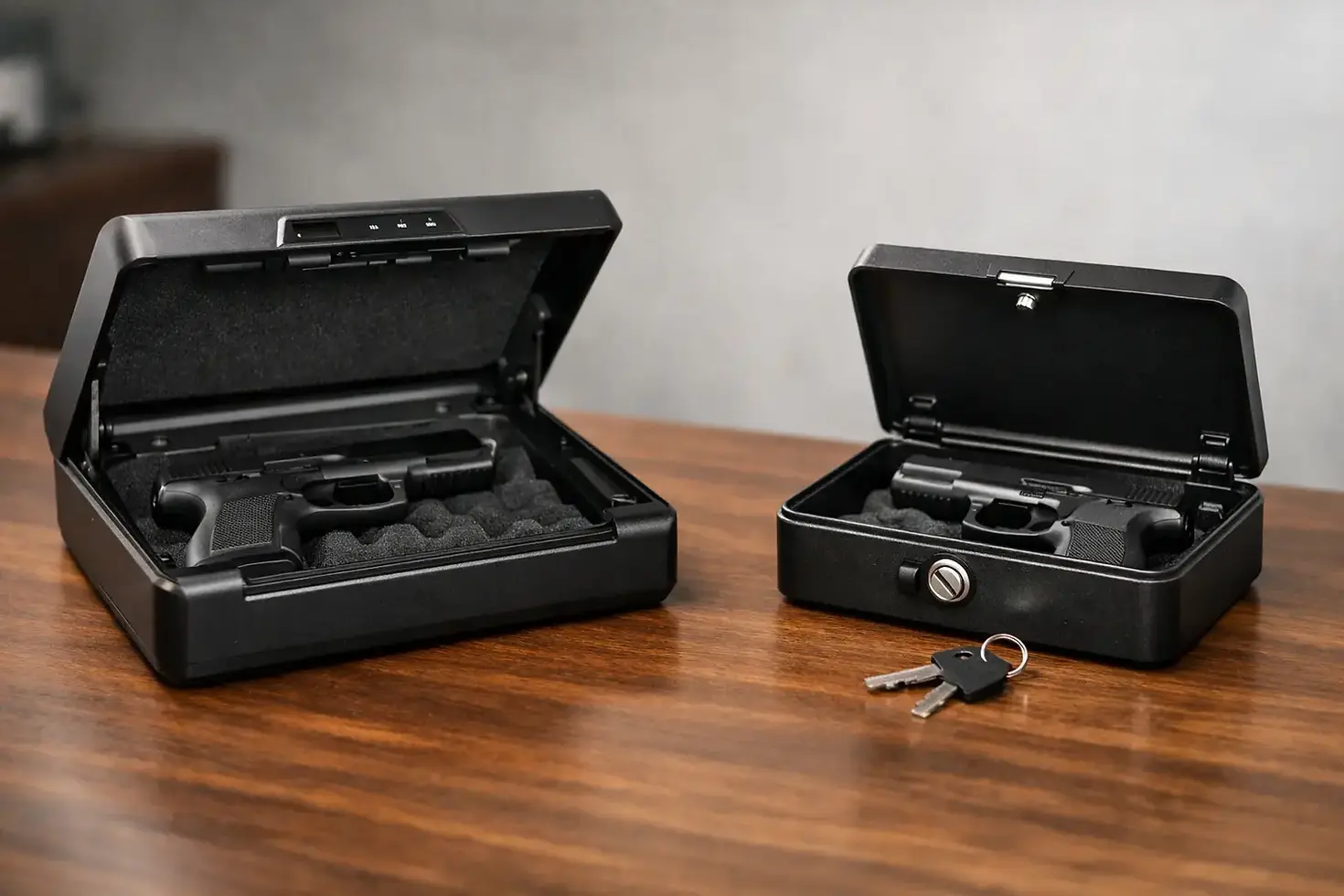
Pistol Safe Versus Lock Box for Ready Access
A handgun left loose in a nightstand, vehicle console, or range bag is not part of a prepared loadout. It is a liability. The pistol safe versus lock box decision comes down to one operational question: what level of security do you need without sacrificing access when seconds, location, and household conditions matter?
Both options can keep unauthorized hands off a firearm. Neither is automatically the right answer for every mission. A bedside defensive pistol, a carry gun staged during the workday, and a handgun transported to the range face different threats. Match the container to the environment, then mount, place, and use it with discipline.
Pistol Safe Versus Lock Box: The Core Difference
A pistol safe is generally built for a fixed role. It is often heavier, designed to be bolted down or secured by a cable, and equipped with a mechanical, electronic, biometric, or RFID access system. Its purpose is controlled, repeatable access at a specific location, usually beside the bed, under a desk, in a closet, or inside a vehicle.
A lock box is usually more compact and more portable. Many use a key, combination, or simple electronic lock, with a steel cable that can anchor the box to a seat frame or other fixed point. It is a practical tool for temporary storage during travel, at the gym, in a hotel room, or when a firearm must be secured in a vehicle.
The dividing line is not just size. A pistol safe is usually a dedicated access point. A lock box is usually a transport and temporary-stowage solution. The right choice depends on whether your primary concern is rapid deployment, theft deterrence, mobility, or all three.
When a Pistol Safe Is the Better Deployment
A pistol safe earns its place when the firearm has a predictable home. For a defensive handgun staged at bedside, rapid but controlled access matters more than the ability to toss the container into a range bag. A quality quick-access safe can keep the pistol available to an authorized adult while preventing a child, guest, or opportunistic intruder from simply opening a drawer.
Bedside and home-defense positions
At home, a safe should be selected around the way you actually move and sleep. A biometric model may be fast for some users, but only if it recognizes your fingerprint consistently with dry hands, rough hands, or under stress. Electronic keypad models are dependable when the buttons are clear and the code can be entered by touch. Mechanical options eliminate battery dependence but may require more deliberate operation.
The best system is the one you can open reliably, in low light, without fumbling. Train with it unloaded. Practice from the position where you will actually access it. Confirm that the door opens fully, the pistol can be drawn without snagging, and the safe does not shift when you operate it.
For a home-defense role, anchoring matters. A heavy safe that is not mounted can still be carried away. Use the manufacturer-approved mounting points, a security cable where appropriate, and a location that cannot be easily seen from a doorway or window. Avoid placing it where moisture, heat, or curious hands can compromise the setup.
Higher theft resistance and equipment protection
A pistol safe is not a substitute for a full-size gun safe when you are protecting multiple firearms or high-value gear. But compared with a lightweight lock box, it generally provides a stronger barrier against casual theft and forced access. Heavier-gauge steel, reinforced locking areas, concealed hinges, and solid mounting hardware all add time and difficulty for an attacker.
That delay has value. Security is rarely about claiming something is impossible to defeat. It is about forcing unauthorized access to take longer, make noise, use tools, and create risk. For a handgun staged in one location every day, a purpose-built pistol safe is usually the stronger position.
When a Lock Box Is the Smarter Tool
A lock box wins when mobility and compact storage drive the mission. It is not meant to be a permanent fortress. It is meant to keep a handgun secured when you cannot keep it on your person and cannot access your primary safe.
Vehicle storage and temporary stops
A vehicle lock box can be useful when entering a location where carry is prohibited or impractical. The box should be discreet, anchored to a solid point, and positioned where it cannot be seen through the glass. A cable through a flimsy seat component is not the same as a properly secured mounting point, so inspect the vehicle layout before relying on it.
Do not treat a vehicle as long-term firearm storage. Heat, humidity, smash-and-grab theft, and inconsistent state or local rules create a poor security environment. If a lock box must be used in a vehicle, keep the storage period as short as possible, remove identifying firearm decals, and avoid handling the firearm in public view.
Travel, hotels, and range days
For road trips and overnight travel, a compact lock box gives you a controlled place to secure a handgun rather than leaving it in luggage, a glove compartment, or an unsecured bag. It is also useful at the range when you need to lock up a sidearm while working with another platform or stepping away from your gear.
Portability brings a trade-off: anything small enough to carry is also easier to steal. A cable improves resistance, but it does not turn a portable box into a bolted-down safe. Choose a model with a solid locking mechanism, protected hinge area, internal foam that prevents unnecessary movement, and enough room for the pistol without cramming it against magazines or accessories.
Access Speed Is More Than the Lock Type
Buyers often focus on whether biometric, keypad, key, or combination access is fastest. The better question is whether the entire setup works under pressure. A fast lock does not help if the box is buried under gear, the safe is mounted at an awkward angle, or the door springs open into your hand.
Biometric access can be highly convenient, especially for a fixed bedside role. It also demands testing. Enroll the same finger more than once if the unit allows it, test it at different angles, and maintain the scanner according to the manufacturer instructions. If a scanner struggles with your hands after training, work, or weather exposure, a keypad may be the more dependable choice.
Keyed lock boxes are simple and avoid electronics, but the key itself becomes a security problem. Hiding it near the box defeats the purpose. Combination locks remove the key issue but can be slower in darkness. Electronic keypads typically balance speed and control well, provided battery status is monitored and backup entry methods are understood before an emergency.
Whatever system you choose, keep the firearm condition consistent with your training and local laws. Storage is only one layer of responsible handling. Muzzle discipline, access control, and a clear plan for household members remain part of the mission.
Build the Right Storage Plan
The strongest setup is often not one container but a layered plan. A mounted pistol safe can cover the home-defense position. A compact lock box can cover lawful travel and unavoidable temporary vehicle storage. A full-size rated safe can secure additional firearms, ammunition, optics, and serialized equipment when they are not in service.
Before buying, evaluate these four realities: who may be in the home, where the pistol needs to be accessed, how long it will be stored there, and whether the container can be physically anchored. If children or unauthorized adults may have access to the area, prioritize secure locking and placement over marginal gains in opening speed. If the container will move frequently, prioritize construction quality, cable compatibility, and discretion.
Also review the safe-storage and transport requirements that apply where you live and where you travel. Requirements can change across state lines, on federal property, and in specific facilities. Your gear should support legal, responsible control of the firearm, not create uncertainty when you are already managing a changing environment.
Choose for the Mission, Not the Marketing
A pistol safe is the better answer for a handgun that needs a secure, repeatable home with fast access. A lock box is the better answer for portable, short-duration storage when a larger secure option is unavailable. Trying to make one do every job usually creates a weak point.
Set the firearm up where it belongs, verify the lock under realistic conditions, anchor the container whenever possible, and keep access limited to trained, authorized users. That is how secure storage becomes part of a mission-ready loadout instead of an afterthought.


Comments