How to Set Up MOLLE Gear Right
A bad MOLLE setup shows itself fast - twisted pouches, dead space, blocked mags, and gear that shifts when you move. If you are figuring out how to set up MOLLE gear, the goal is not to hang every pouch you own on a vest or pack. The goal is to build a loadout that stays secure, clears your draw, balances weight, and gives you fast access when the pressure spikes.
MOLLE is simple in theory and unforgiving in practice. The platform gives you modularity, but it also gives you enough rope to build a clumsy rig if you do not start with a plan. A clean setup is built around mission, body mechanics, and repetition. Whether you are configuring a plate carrier, chest rig, battle belt, or assault pack, the same rule applies - mount only what supports the job.
How to set up MOLLE gear starts with the mission
Before you weave a single strap, define what the loadout is supposed to do. A range rig, home-defense carrier, training belt, and field pack should not wear the same layout. Too many users copy someone else’s setup without thinking through distance, duration, terrain, and whether they are standing on a flat range or moving over rough ground.
Start with your core tasks. Are you carrying rifle mags only, or do you need medical, admin, comms, and hydration? Are you building for a few hours of training or a full day outdoors? Those answers determine pouch count, pouch size, and where each item belongs. The cleaner the mission profile, the better the setup.
This is also where discipline matters. MOLLE lets you expand, but expansion is not always improvement. Every extra pouch adds weight, bulk, snag points, and heat. If the item is not essential to the role, leave it off.
Build around access, not appearance
The strongest-looking setup on a hanger can turn into a liability once you kneel, sprint, shoulder a rifle, or get in and out of a vehicle. A good MOLLE layout is shaped by movement. You need access with either hand when possible, consistent indexing under stress, and enough clearance to run your primary weapon without fighting your own kit.
Magazine pouches are the first major decision. Most right-handed shooters keep rifle mags on the front or support side where the support hand can retrieve them cleanly. Pistol mags usually sit on the support side as well, often farther left on a belt. If you crowd the front of a plate carrier with too many stacked pouches, you increase thickness and make it harder to get low in prone. That may be acceptable on a short-duration setup, but it is a poor trade if you expect sustained movement or positional shooting.
Medical gear should be reachable and obvious. If you run an IFAK, mount it where you or another person can get to it fast. The exact position depends on your platform and body type, but the standard is simple - do not bury life-saving gear behind utility pouches or mount it where it gets pinned against a seat or pack.
Dump pouches, radios, admin pouches, and general-purpose pouches come after ammunition and medical. They support the loadout, but they should not compromise your primary reloads or weapon presentation. If they do, the setup is backwards.
Weave it correctly or expect failure
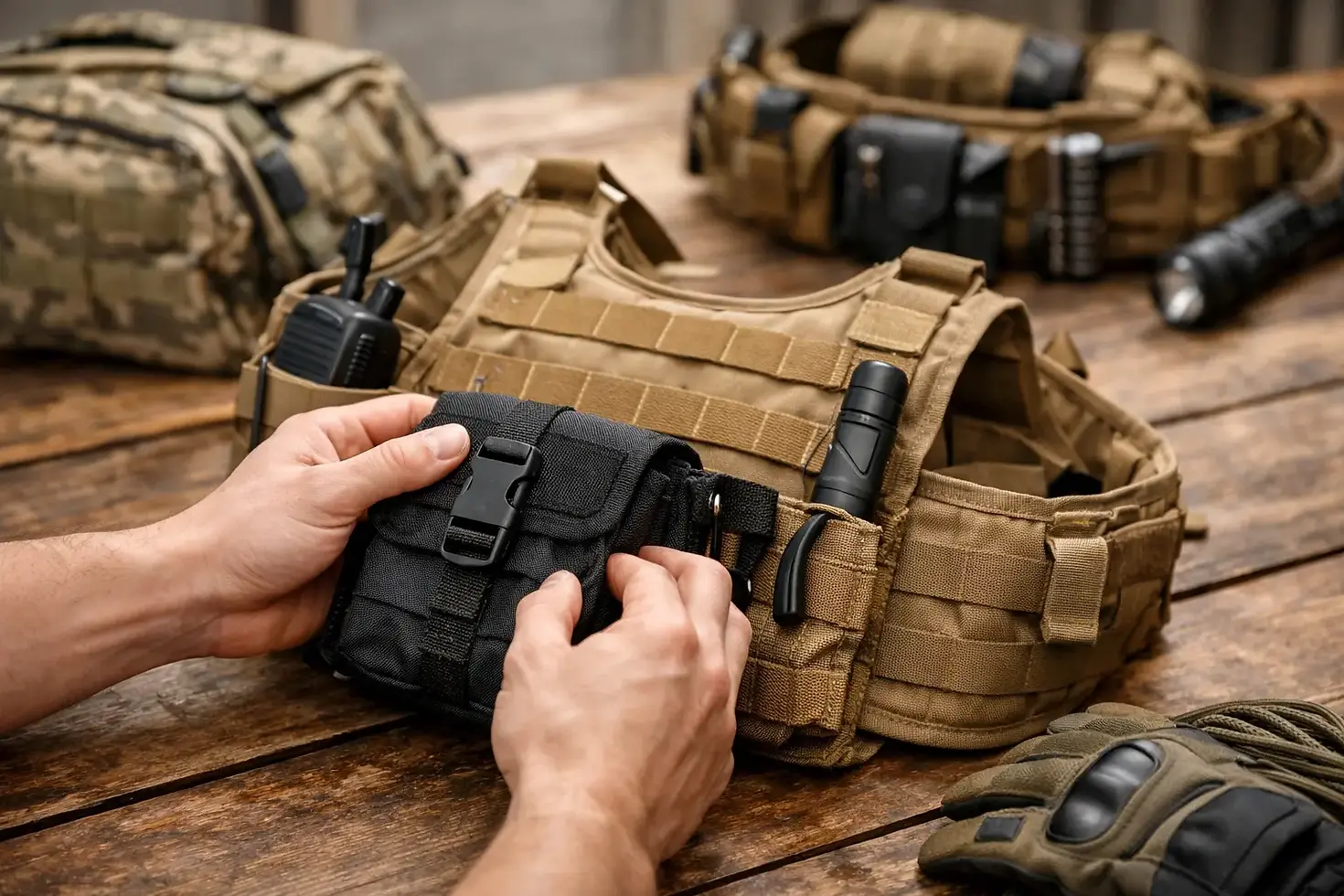
This is where plenty of loadouts go wrong. The pouch may look attached, but if the straps are not woven properly through both the pouch webbing and the platform webbing, it will sag, bounce, or peel away under movement. That is not just sloppy. It is operationally weak.
When attaching MOLLE pouches, feed each strap through the platform row, then back through the pouch row, alternating all the way down. That interlocking weave is what creates a stable mount. If you skip rows or just slide the strap straight down the back, the pouch will move more than it should.
Once secured, test it hard. Pull on the pouch, shake the carrier, jog with it, and practice reloads. If the pouch shifts, the weave is wrong or the pouch is a poor fit for the platform. Fix it before you load it out.
Balance the load across the platform
Heavy gear clustered in one area will punish you over time. On a plate carrier, too much front weight can drag the shoulders, pull the carrier down, and create unnecessary fatigue. On a belt, loading one side with magazines and tools while leaving the other side empty can create hot spots and bounce.
Try to keep the heaviest essentials centered or evenly distributed. A common example is stacking too many rifle mags on the front panel while adding a radio and admin pouch on the same side. That setup may feel acceptable standing still, but it gets old fast during movement drills or long range sessions.
There is always a trade-off. Front-mounted magazines are fast to access, but too much depth interferes with prone shooting and vehicle work. Side-mounted items free the front, but they can widen the profile and affect arm swing. The right answer depends on how you actually use the gear. If the loadout is for static range work, you can tolerate more bulk. If it is for dynamic training or outdoor movement, trim it down.
How to set up MOLLE gear on different platforms
A plate carrier should stay focused. Armor, magazines, medical, and maybe one utility function are usually enough. The more you turn a carrier into a backpack, the worse it performs. Keep the front slick enough to shoulder a rifle and get low when needed. Side space can support a radio or small utility pouch, but overloading the cummerbund is a common mistake.
A battle belt is where speed matters most. Mount pistol mags, a rifle mag if that supports your system, medical, and essential tools where the draw path stays clean. Avoid placing bulky pouches directly where they block your pistol draw or dig into your hips while seated. Belts reward minimalism.
A chest rig can handle a little more front-loaded storage because that is the point of the platform, but even there, thickness matters. If the rig rides too far off the body or becomes top-heavy, reload speed and comfort drop quickly.
Packs are different. On an assault pack or day pack, use MOLLE for items you need externally, not as a place to hang every spare item. External pouches make sense for quick-access medical, hydration support, or tools that would otherwise bury the main compartment. Too many outside pouches can throw off balance and snag in brush or tight spaces.
Run a dry test before you call it done
A fresh setup always looks better than it performs. You do not know if the pouch placement works until you move with it. Put the loadout on and run basic tasks. Shoulder your rifle on both sides. Practice reloads. Go prone. Kneel. Sit in a vehicle seat. Work around barriers. If something pinches, blocks, flops, or slows your hands, it needs to move.
This is where ego gets exposed. A lot of gear layouts are built for photos, not use. Real testing strips that away. If a pouch placement costs time, changes your draw stroke, or keeps getting caught on slings and seats, it is a bad placement no matter how clean it looked on day one.
It also helps to test in stages. First run the base loadout with mags and medical. Then add the secondary items one at a time. That makes it easier to identify what actually caused the problem.
Common setup mistakes that kill performance
The biggest mistake is overloading the platform. The second is poor placement. The third is using cheap or mismatched pouches that do not fit the intended magazines, tools, or medical contents well. A pouch that is too loose slows retention. One that is too tight slows access. Either way, performance suffers.
Another common failure is ignoring body type. Taller users, shorter users, broad shoulders, narrow waists - all of that affects where pouches ride best. There is no universal layout that works for everyone. Copying a professional-looking loadout without adjusting for your frame and use case is a fast way to build discomfort into every rep.
Finally, do not confuse more modularity with better readiness. The best setups are usually boring. They are repeatable, secure, and efficient. That is what mission-ready looks like.
If you want your MOLLE gear to perform when it counts, think like an operator, not a gear collector. Keep the loadout lean, place every pouch with purpose, and let movement testing make the final call.


Comments