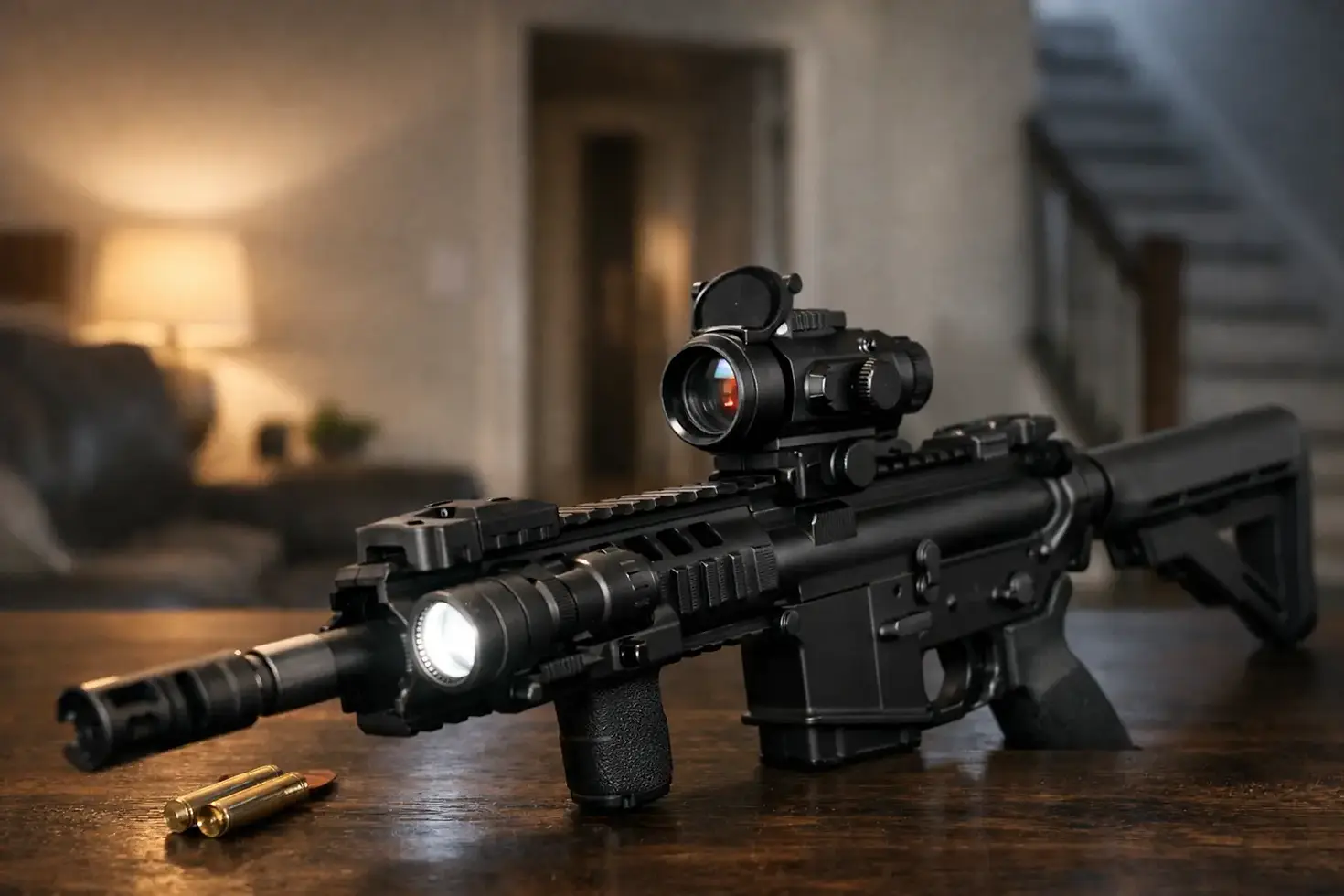
What Optic for Home Defense AR-15?
At 2 a.m., you are not solving a range puzzle. You are identifying a threat, moving through tight angles, and trying to make fast, clean hits under stress. That is why the question of what optic for home defense AR-15 owners should run is not about trend chasing. It is about speed, reliability, and control when the environment is close, dark, and unforgiving.
For most shooters, the right answer is simple: a quality red dot sight. Not a high-magnification scope. Not an oversized competition setup. Not a budget optic with questionable durability. A dependable red dot gives you the fastest sight picture at home-defense distances, works well in low light, and keeps your focus on the target instead of the optic.
What optic for home defense AR-15 setups actually need
Home defense distances are short. Across a bedroom, down a hallway, through a doorway, maybe across a larger living room. You are not dialing for distance or reading wind. You need an optic that comes on target immediately, stays visible in mixed lighting, and does not turn your rifle into a bulky liability indoors.
That changes the mission profile. An optic for a patrol rifle, a range rifle, and a home-defense AR-15 can overlap, but they are not always the same assignment. Inside a home, target acquisition matters more than magnification. A wide field of view matters more than precision at 300 yards. Simplicity matters more than feature overload.
That is why red dots dominate this role. They are fast, forgiving, and easy to run from awkward positions. If your rifle is staged for defensive use, the optic needs to support immediate action, not slow it down.
Why a red dot is the default choice
A red dot is built for close-quarters speed. Keep both eyes open, drive the rifle to the target, and place the dot where you need the round to go. That is a major advantage when your heart rate spikes and your visual processing narrows.
It also helps in low light. Iron sights can disappear against dark backgrounds. A clear illuminated aiming point stands out faster, especially when paired with a weapon light. In a defensive encounter, faster sight confirmation can be the difference between hesitation and control.
There is also a training advantage. Newer shooters generally learn a red dot faster than irons or magnified optics. More experienced shooters can run them harder and more efficiently. That makes the red dot the best fit for the broadest range of home-defense users.
But not all red dots are equal. The mission calls for real durability, predictable battery life, and a brightness range that works indoors without blooming into a starburst. Cheap optics fail at the worst time. On a defensive rifle, that is not acceptable.
The best optic types for home defense
Full-size red dot sights
A full-size red dot is the strongest all-around option for most home-defense AR-15 builds. These optics usually offer excellent battery life, durable housings, and larger windows that are easy to pick up under pressure. They balance speed and survivability well, especially on a rifle that may sit staged but still needs to perform instantly.
This category includes proven designs from brands serious shooters trust for duty-grade use. If you want an optic that can take recoil, impacts, and real-world abuse, this is where you should be looking.
Micro red dots
Micro red dots keep the rifle light and compact. That matters on a short AR-15 configured for indoor work. Less bulk can make the rifle easier to maneuver around corners, door frames, and confined spaces.
The trade-off is window size. Some shooters are extremely fast with micro dots. Others find them slightly less forgiving during rushed presentations. If you train regularly and value a lighter package, a good micro red dot is still a strong option.
Holographic sights
Holographic sights are also excellent for home defense. They offer fast target acquisition and a reticle many shooters find easier to track than a simple dot. They tend to perform well in dynamic shooting and can be extremely effective in close-range defensive use.
The trade-off is battery life. Compared to many red dots, holographic sights usually demand more battery management. If you are disciplined about maintenance, that may be a non-issue. If you want maximum set-it-and-stage-it convenience, a red dot usually wins.
LPVOs for home defense
A low power variable optic can work, but it is rarely the first recommendation for a dedicated home-defense AR-15. On 1x, some LPVOs are fast enough. But they are generally heavier, more complex, and less forgiving than a good red dot in a close indoor environment.
If your rifle also serves as a ranch, perimeter, or general-purpose carbine, an LPVO might make sense as a compromise. For a rifle built specifically for bedroom-to-hallway distances, it is usually more optic than the mission requires.
What to look for when choosing the right optic
Durability comes first. A home-defense optic should be able to handle recoil, movement, bumps, and long-term readiness. Look for strong housings, dependable mounting systems, and a track record that goes beyond marketing copy.
Battery life matters more than people admit. A defensive optic should either run for years on a practical setting or force you into a battery-change schedule you will actually follow. Constant-on capability is a major advantage because it removes one more task from a high-stress moment.
Brightness control is another big factor. The optic must be bright enough to stand out in daylight near windows or exterior spill light, but also capable of dimming enough for dark indoor use. An optic that blooms badly in low light slows you down.
Reticle simplicity helps. For home defense, a clean dot or uncomplicated reticle is usually ideal. This is not the place for busy holdover systems intended for distance work. Keep the visual information lean and fast.
Mount height is worth attention too. Many shooters prefer absolute or lower one-third co-witness height on an AR-15. Either can work. What matters is getting a natural head position and consistent presentation from ready to target.
What optic for home defense AR-15 buyers should avoid
Avoid bargain-bin optics with no proven performance record. A defensive rifle is not the place to test cheap electronics, soft mounts, or vague warranty promises. If your optic loses zero, flickers, or dies without warning, the low price was a false economy.
Avoid excessive magnification. A 3-9x scope belongs on a different mission set. Indoors, magnification narrows your field of view and slows your ability to process what is happening around you.
Avoid oversized setups that make the rifle front-heavy and awkward. Home defense is about movement and control in confined space. Every ounce and every inch of unnecessary bulk works against that.
Also avoid overcomplicating the rifle. A home-defense AR-15 should be configured for immediate use. Optic, white light, sling if appropriate, and a setup you have actually trained with. Clean, efficient, mission ready.
A realistic setup that works
For most shooters, the ideal formula is a quality 1x red dot, mounted properly, paired with a dependable weapon light and backup irons if desired. Zero it correctly, confirm it with your defensive load, and train with it in low light. That setup covers the mission without clutter.
If you want a more premium package, a duty-grade micro red dot or holographic sight can deliver excellent performance. If your rifle has to serve both home defense and more open-area use, then an LPVO or magnifier setup may be justified. But be honest about the rifle’s primary role. Most problems inside a home are solved with speed, not magnification.
That is where a specialized source matters. Retribution Tactical focuses on mission-ready optics and rifle accessories built for serious use, not casual shelf filler. When the requirement is dependable gear for a defensive carbine, that kind of curation matters.
The final call
If you are still asking what optic for home defense AR-15 use makes the most sense, start with a proven red dot and do not overthink the mission. Get something durable, keep it powered, pair it with a white light, and train until the rifle comes up the same way every time. The best optic is the one that helps you identify faster, aim cleaner, and hold the advantage when everything gets loud in a hurry.


Comments